
Most companies are still waiting for AI to pay for itself. Meanwhile, an agent just did a weekend of my bookkeeping in an afternoon. The difference has nothing to do with intelligence, and everything to do with what the AI can see.
Listen: AI Agents Were Supposed to Save You Time. Here's Why They Haven't Yet. (10 min)
Last week I handed an AI agent a year of credit card statements and asked it to get my books ready for tax season.
It read every transaction into a clean table, matched them against my bank records, and sorted all the spending into categories. At one point it flagged a Brightline train ticket that had been filed under restaurants, corrected it, and re-ran the totals until everything tied out. I was doing other things the whole time.
If that sounds nothing like your experience with AI, this post is for you. Because the strange truth of 2026 is that both of these are real at the same time: agents quietly doing days of work for some people, and AI pilots failing for almost everyone else. The line between those two outcomes is thinner than you would guess, and it has almost nothing to do with how smart the AI is.
Why the AI you were promised has not shown up
Think about where your work actually happens on a normal Tuesday. The deal conversation is in Slack. The client's last message is in Gmail. The pipeline is in HubSpot. The proposal is in Google Drive. You are the only thing connecting all of it, which is why "AI will handle your follow-ups" keeps not happening. The AI cannot follow up on a conversation it cannot see.
Two things stand between you and AI that actually does your busywork.
First, your work lives in too many places. The average company now runs 101 different software tools, according to Okta's Businesses at Work report. For an AI agent to be useful, it has to reach into those tools the way you do: read the email thread, check the calendar, update the deal, find the document. Every tool it cannot reach is a task it cannot finish.
Second, the do-it-yourself route is much harder than it looks. The popular path for technical people is to wire up an open source agent toolkit. The best known of these, OpenClaw, has more than 160,000 stars on GitHub, and it is genuinely capable. What nobody puts in the demo video is the weeks that follow: authorizing every app connection by hand, managing security keys, keeping the whole thing patched and safe. And when the wiring is finally done, a harder question is waiting, and it is not technical at all: where does the truth about your business actually live? Which app has the right phone number for that contact? Who fixes the duplicates?
That last question is where projects quietly stall. Nearly half of organizations told Deloitte their data is not organized in a way an agent can use. An AI that can touch everything but understands nothing about how your business fits together is not a time saver. It is one more thing to manage.
Do not take our word for it
You have probably seen dramatic AI failure numbers thrown around, and some of them deserve the side-eye they get. So here is the careful version, skeptics welcome. It still tells the same story:
- Gartner predicts more than 40 percent of agentic AI projects will be canceled by the end of 2027, citing rising costs, unclear business value, and weak risk controls.
- You may have seen the viral MIT claim that 95 percent of company AI pilots fail. That number earned real criticism: it only counted pilots that showed profit-and-loss impact within six months, a bar plenty of good projects would miss. But strip away the headline and even the critics broadly accept the diagnosis underneath it: tools that never learn how a business actually works never get past the demo stage.
- Deloitte's Tech Trends 2026 found that only 11 percent of organizations have AI agents running in real day-to-day operations, even though 38 percent are piloting them.
- An IDC study of more than 900 enterprises found that 97 percent have not figured out how to scale AI agents beyond experiments.
- And the oldest finding in data science still holds: 60 to 80 percent of the work in any AI project goes into collecting, cleaning, and organizing information, a figure Forbes popularized nearly a decade ago that has barely moved since.
Notice what none of these say. None of them say the AI is not smart enough. The intelligence is ready. What fails is everything around it: the connections to your tools, and the organized information the AI needs to act on your business instead of guessing about it.
What the fix looks like
This is exactly the problem we built Alani Insights to solve. It handles both hard parts for you, with no code and no technical setup.
Your tools, already connected
From the moment you sign up, your agent can securely reach the apps where your work already lives: email, calendar, CRM, files, and hundreds more, through our integration partner Composio. These are the same production-grade connections an engineering team would spend months building, except the months already happened. You click, you authorize, you are connected.
A memory of your business
The second part is the one almost nothing else gives you: structured memory. In Alani, your business runs on simple data tables you describe in plain English: your contacts, your companies, your deals, your meeting notes, whatever your work is made of. Every record has real fields and real history, so your agent is never guessing where the truth lives. When you ask it to follow up with everyone you met last week, it knows exactly who that is, what you talked about, and what should happen next.
That memory is the difference between an AI that gives impressive demo answers and one that quietly gets your actual work done every day. It is also what made the bookkeeping story at the top of this post possible: the statements became a table, the table talked to my bank records, and the agent had everything it needed to reason with.
What changes when the plumbing is done
The pattern extends to any work that is really "read from these places, think, then write to those places." Back from a conference with thirty new contacts? The agent files them, researches each one, and drafts the follow-ups. Monday morning? It has already read your calendar and pulled together what you need to know about everyone you are meeting. End of quarter? Your pipeline summary is waiting, built from records it kept current all along.
None of this work is glamorous. That is the point. It is the work that eats your evenings, and it is exactly the work an agent with connected tools and real memory does well.
The bottom line
AI does real work when it can reach your tools and see your business clearly. It fails when it cannot. Everything else in the discourse is noise.
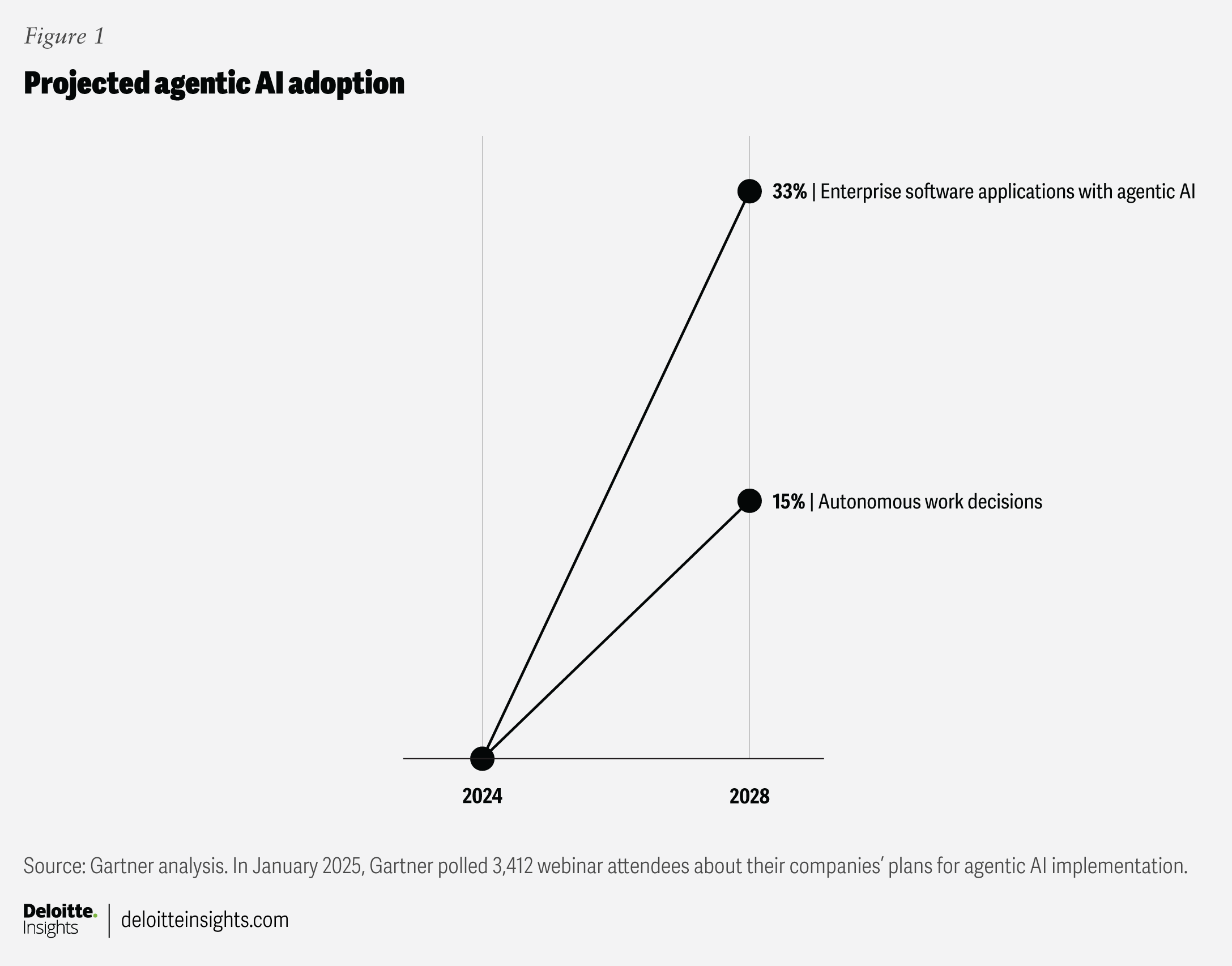
And the clock is running either way. Gartner projects that by 2028, a third of the software companies already use will have agentic AI built in, up from under 1 percent today, and 15 percent of day-to-day work decisions will be made autonomously, up from essentially zero in 2024. Agents are coming to your stack whether you prepare or not. The only question is whether your business will be organized enough for them to be useful when they arrive.
So the advantage in this era does not go to whoever fights hardest with the technology. It goes to whoever hands their AI the clearest picture of their business, then spends their own attention where machines are useless: judgment, taste, and relationships.
Frequently asked questions
Why do most AI agent projects fail?
Rarely because of the AI itself. Gartner points to rising costs and unclear business value, and MIT points to tools that never learn how each business actually works. In practice, most of the effort goes into connecting tools and organizing data, and most projects run out of time or patience before that groundwork is done.
What is an AI agent, in plain terms?
A chatbot answers when you ask it something. An AI agent goes further: you give it a goal, and it plans the steps, works across your tools, checks its own results, and keeps going. Think less answer machine, more capable assistant who can actually use your apps.
Do I need to know how to code to use Alani Insights?
No. You describe your data tables in plain English, connect your existing tools with a few clicks, and tell the agent what you want done. Everything that normally requires an engineering team happens behind the scenes.
How is this different from ChatGPT?
ChatGPT is brilliant, but it has no lasting memory of your business and cannot reach into your tools on its own. Alani gives an AI agent both: secure connections to the apps you already use, and structured memory of your contacts, deals, and history. Its answers and actions are about your business specifically, not businesses in general.
Try it with the hard parts already done
If your week still involves being the human bridge between Gmail, Slack, and your CRM, we want to make this easy. Start at Alani Insights with $20 in free credit on us, plenty to connect your tools and put an agent to work on something real.
Want a guide? Book a free 30 minute consultation and we will map your first workflow together.
Sources
- Gartner. "Gartner Predicts Over 40% of Agentic AI Projects Will Be Canceled by End of 2027." Press release, June 25, 2025.
- MIT NANDA. "The GenAI Divide: State of AI in Business 2025." As reported by Fortune, August 18, 2025.
- Okta. "Businesses at Work 2025." March 2025.
- Deloitte Insights. "The Agentic Reality Check: Preparing for a Silicon-Based Workforce." Tech Trends 2026. Includes Gartner's January 2025 poll of 3,412 webinar attendees projecting agentic AI adoption through 2028.
- IDC. "Agentic AI Adoption Study." Survey of more than 900 enterprises worldwide, commissioned by AWS, 2025.
- Gil Press. "Cleaning Big Data: Most Time-Consuming, Least Enjoyable Data Science Task, Survey Says." Forbes, March 23, 2016.
Gartner does not endorse any vendor, product, or service depicted in its research publications. The opinions in this article are bundleIQ's own.



Ready to put your information to work?
Pick a product. Start free or talk to our team.