
The AI shift that Gartner just called, and what it means for how you manage relationships.
Listen: Your CRM Has Been Waiting for This Moment (12 min)
There's a moment in every technology cycle where the analysts catch up to what the builders already know.
That moment just happened for CRM.
In February 2026, Gartner published Innovation Insight: Agentic AI in CRM, a research note that draws a hard line between the AI of the past few years and what's coming next. The conclusion is blunt: the era of passive AI is over. The age of agentic AI has begun.
If you've been watching this space, none of that surprises you. But the details of what Gartner says this actually requires, and how almost nobody is doing it correctly, are worth understanding. Because buried in the framework is a blueprint. And it looks a lot like what we've built.
First, zoom out. What's actually changing?
For the last several years, AI in CRM has meant one thing: a smarter assistant. You ask it to draft an email. It drafts the email. You ask it to summarize a call. It summarizes the call. Useful? Yes. Transformative? No.
The reason is simple: generative AI waits to be asked. It's reactive by nature. You prompt it, it responds, and then it stops. The human is still doing all the thinking about what needs to happen next.
Agentic AI works differently. It doesn't wait for a prompt. It pursues goals. It plans. It reasons across systems. It acts, and then it acts again based on what it learned from acting the first time.
Gartner frames this shift as a change in what organizations are actually managing. It's no longer software plus humans. It's a digital workforce: autonomous agents that operate alongside your team, handling tasks, making decisions, and executing workflows without being micromanaged at every step.
For CRM, this means the difference between a tool that helps you write follow-up emails and a system that manages your entire customer relationship: capturing, enriching, analyzing, and surfacing exactly what you need, when you need it, without you having to ask.
The market is moving fast. Maybe faster than you think.
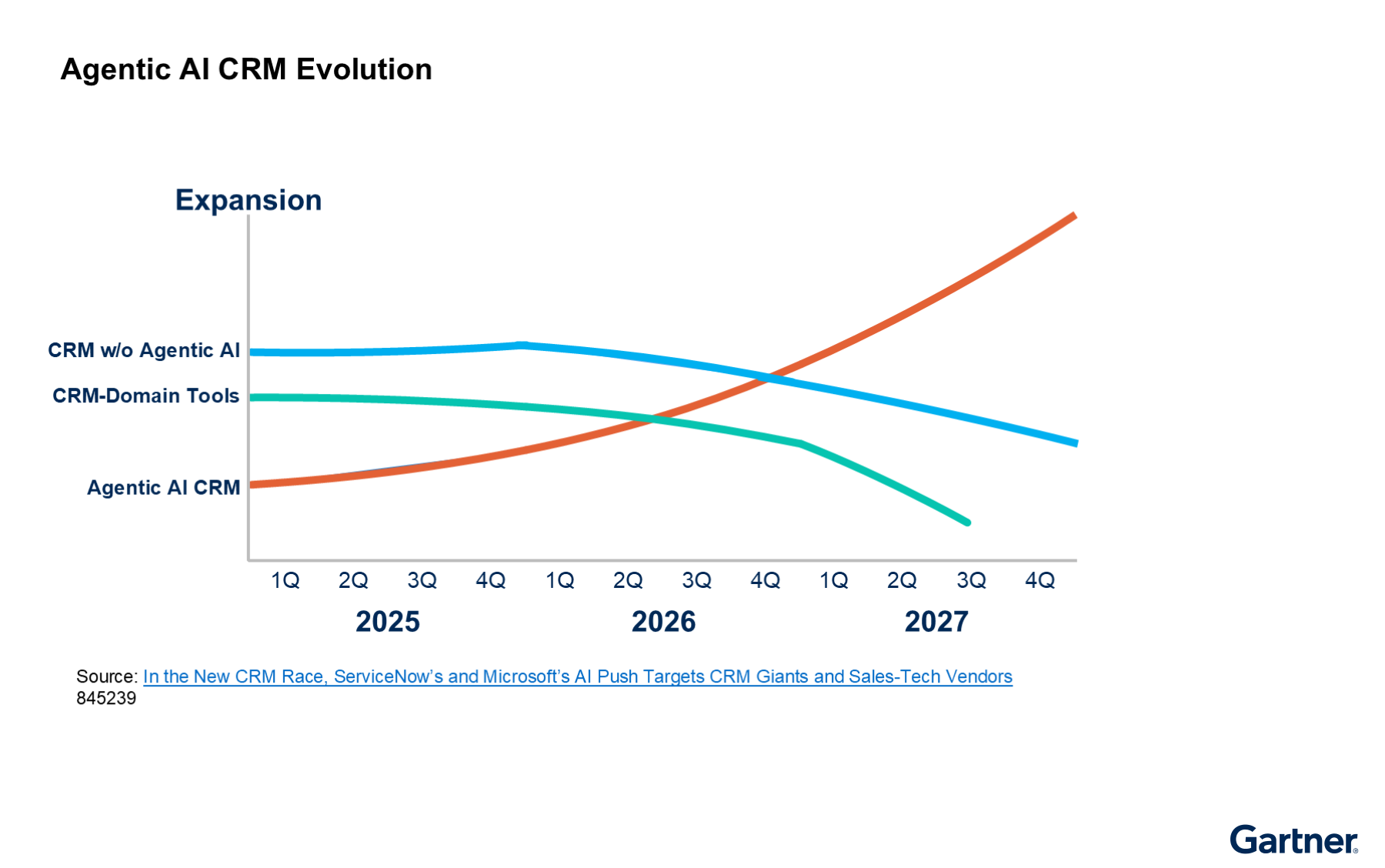
Gartner tracks the CRM market evolution across three tiers:
- CRM without agentic AI: legacy systems doing what they've always done.
- CRM domain tools: single-purpose AI applications solving one problem well.
- Agentic AI CRM: unified, intelligent platforms that coordinate across your entire customer stack.
The first tier is fading. The second tier, and this is the uncomfortable part for a lot of companies who built clever point solutions, is also fading. Gartner's data shows the third tier in clear expansion, accelerating through 2026 and into 2027.
The vendors who recognized this early are already racing. Salesforce, Microsoft, SAP, Oracle: they're all making aggressive moves toward unified agentic platforms. The pressure on everyone else is real, and it's increasing.
But here's what the market share charts miss: most of what's being called "agentic AI CRM" isn't actually agentic. It's generative AI with a new label. And Gartner's framework makes that gap visible.
What a real agentic AI CRM actually needs to do
Gartner is specific about this. Not every feature is equal. There's a mandatory tier, the things that must be present for a system to legitimately claim the agentic AI CRM category, and a common tier of differentiating capabilities.
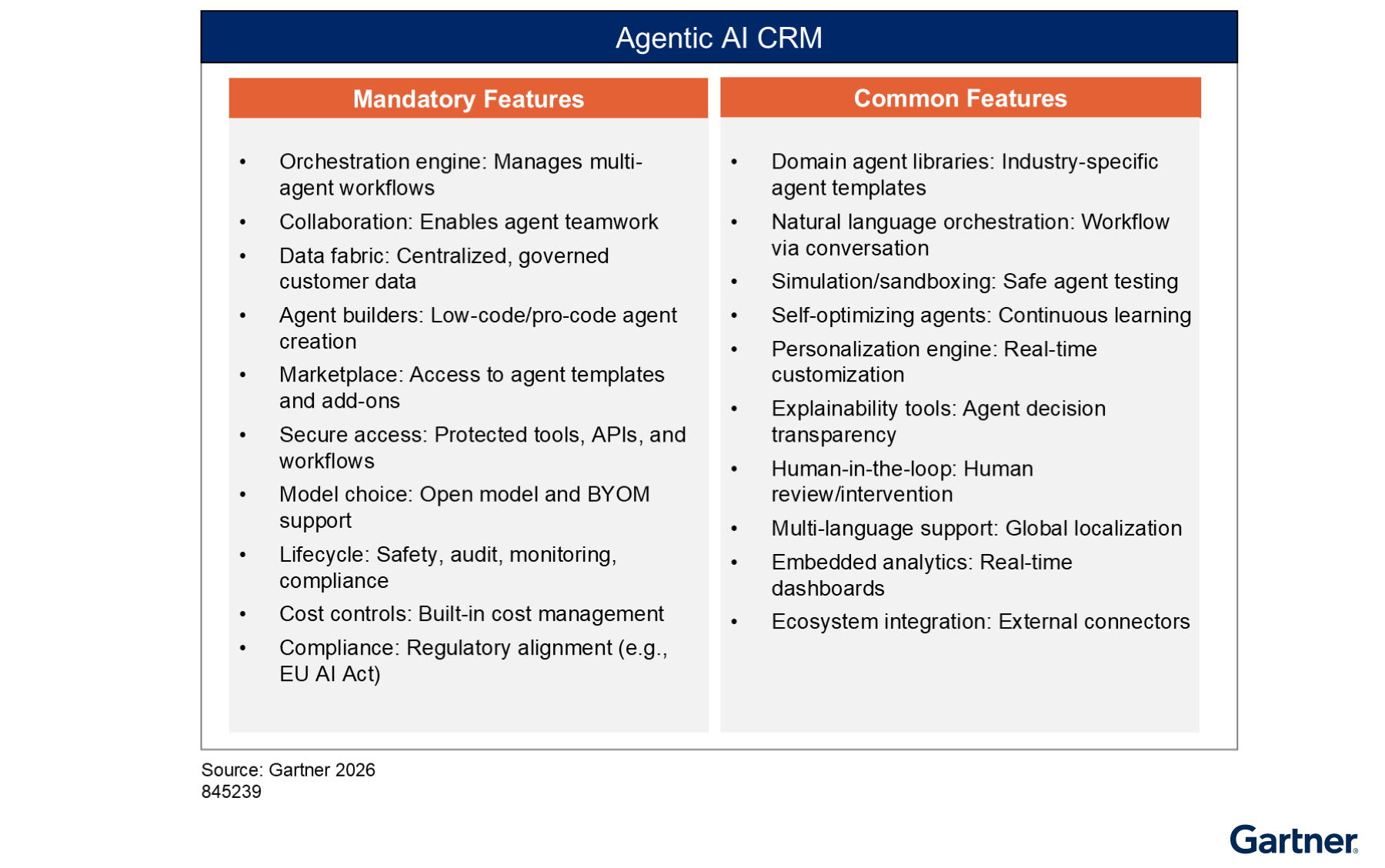
The mandatory list includes what you'd expect: an orchestration engine to coordinate multiple agents, a data fabric to centralize and govern customer data, secure access controls, lifecycle management, compliance alignment. But two items on the list are the ones most vendors quietly skip:
Model choice. The ability to use any AI model, including bring-your-own, rather than being locked into a vendor's proprietary system. This matters because the model landscape is changing every few months. Locking your CRM intelligence to one provider's model is a strategic liability.
A metadata-driven data fabric. A system that understands your organization's data, not just data in general. This is the one that almost nobody gets right. Generic AI on generic data produces generic insights. A system that understands your schema, your relationships, your context, and generates intelligence specific to your organization, is a categorically different thing.
Gartner also highlights a risk that most people underestimate: agents that reach conclusions through non-repeatable paths create compliance nightmares. If you can't explain how your AI arrived at a decision, you can't audit it, you can't defend it, and you can't trust it at scale.
Now zoom in. Here's what we built.
We started with a simple, honest observation about conferences: you meet a hundred people and remember three. The business cards pile up. The conversations blur. The warmest leads of the year go cold before you land.
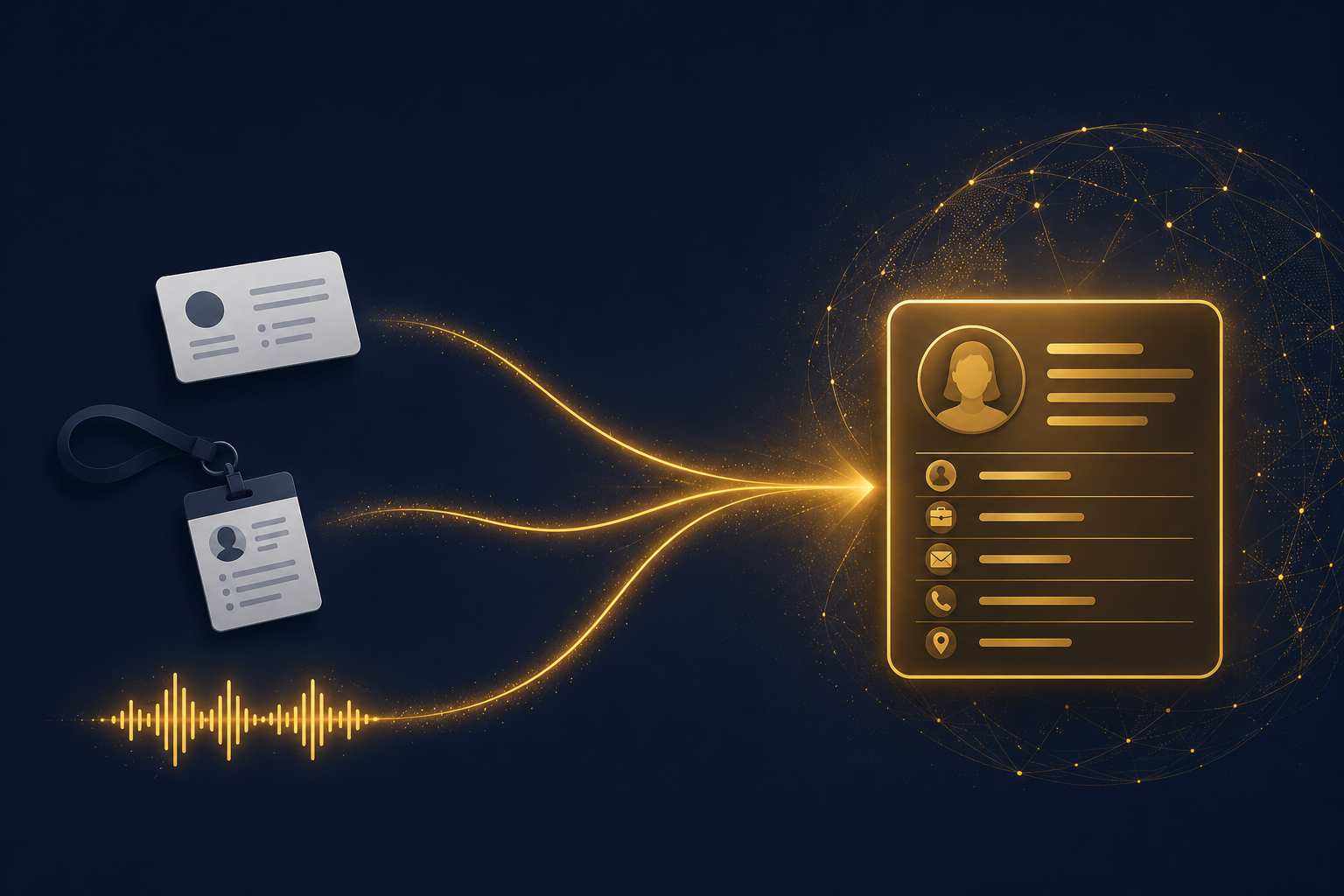
ConferenceCRM was built to solve that: a CRM that lives inside Claude, captures contacts by voice or badge photo, and researches everyone automatically before you've left the conversation. No new app. No typing. No friction.
That's the front door. It's a real problem, solved elegantly. But it's the entry point to something architecturally more significant.
The product underneath is a full CRM. And the intelligence layer, Alani, doesn't work the way most AI CRM tools work.
Most AI CRM tools sit on top of your data and generate responses based on general patterns. Alani generates personalized, contextualized SQL per organization. That's not a technical detail. It's the whole architecture. It means Alani understands your data schema. It knows your tables, your relationships, your field names, your organizational context. When you ask a question, the answer comes from a query built specifically for your CRM, not a generic approximation.
Alani Insights: the platform you build on
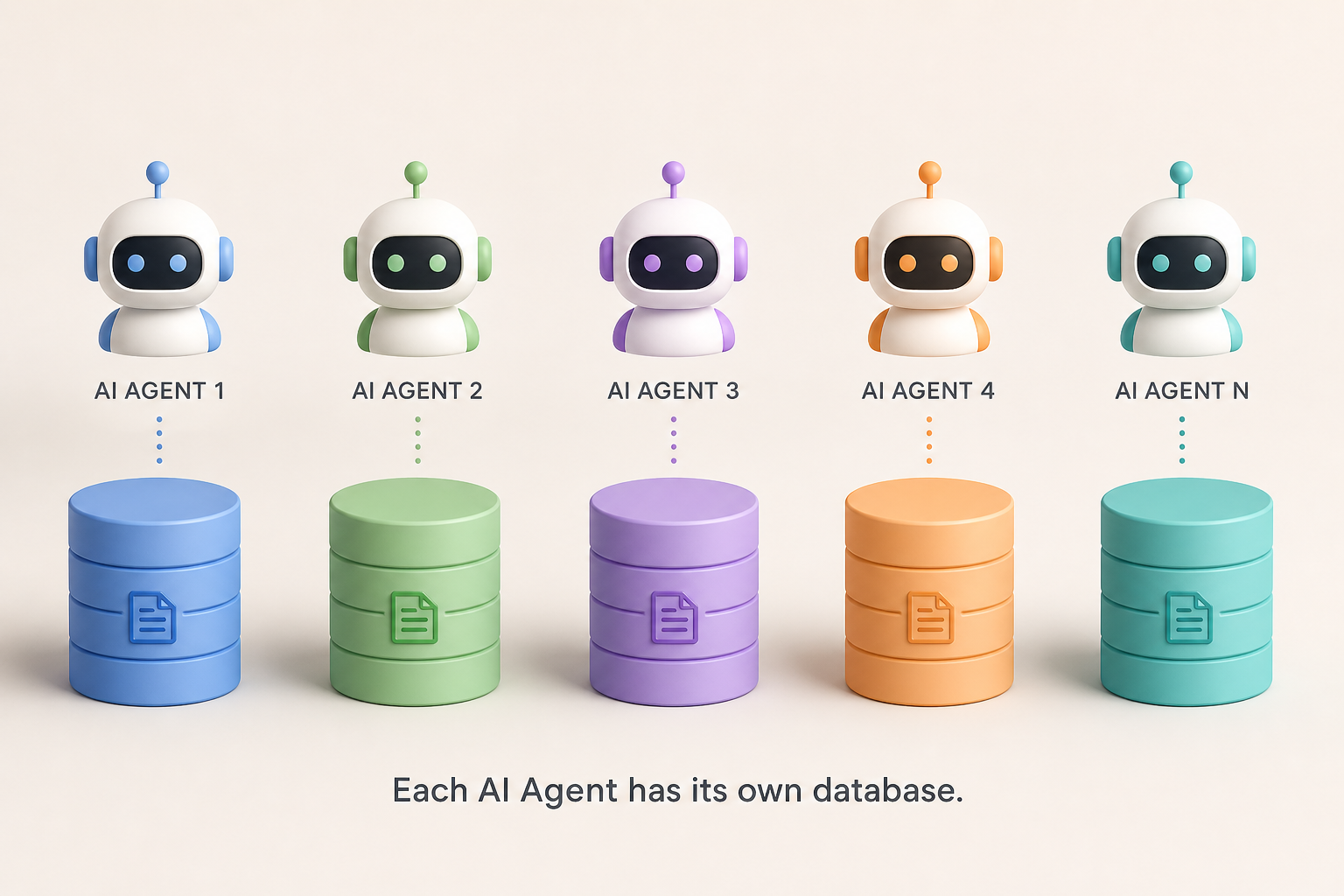
Here is the part that matters most. ConferenceCRM is not a one-off product. It is one database we built and curated on Alani Insights, our AI-native database platform. And you can build your own.
An AI-native database is structured for agents from the ground up, not a legacy database with AI bolted on. It is centralized, governed, queryable, and ready for agent orchestration on day one. That is the foundation Gartner says an agentic AI CRM has to have, and it is the part almost everyone else is still trying to retrofit.
With Alani Insights, you do not need a data team to get there. You curate and build your database inside the platform itself. Bring your raw material, a photo, a spreadsheet, a stack of notes, a conversation, and Alani structures it into clean records, works out the schema, and hands your agents a database they can query, reason over, and act on. You shape it, you govern it, and it is yours.
ConferenceCRM is what that looks like pointed at conference contacts. Point it at a sales pipeline, an operations tracker, a research library, or a support desk, and you get the same thing: an AI-native database, built and curated by you, ready for agents to orchestrate. This is where CRM, and a lot more than CRM, is going. Alani Insights is how you build it now.
Why that matters more than it sounds
Think about what Gartner is asking for when it mandates a data fabric: a system that aggregates, cleanses, and governs customer data, providing agents with consistent, high-quality, real-time information. A system that can be trusted to make decisions because the data underneath it is sound.
Contextualized SQL per organization is exactly that. And it quietly solves another one of Gartner's hardest problems: auditability.
SQL is deterministic. Every query Alani runs is traceable. You can see exactly what data was accessed, exactly what logic was applied, exactly what produced the insight you're looking at. Gartner specifically flags agents that reach conclusions through non-repeatable paths as a compliance liability. SQL is the opposite of that: a path you can follow backwards, every time, without ambiguity.
This also maps to what Gartner calls the personalization engine, but at a deeper level than the term usually implies. Most vendors use "personalization" to mean customized customer-facing content. Alani's personalization is at the intelligence layer itself. The AI isn't generic. It's specific to you.
The Gartner risk map, and where this sits on it
Gartner is honest that most enterprises are still in early pilot stages with agentic AI CRM, rated high risk, significant potential value. The primary risk factor identified is the burden of technical debt. The primary value driver is increasing employee productivity.
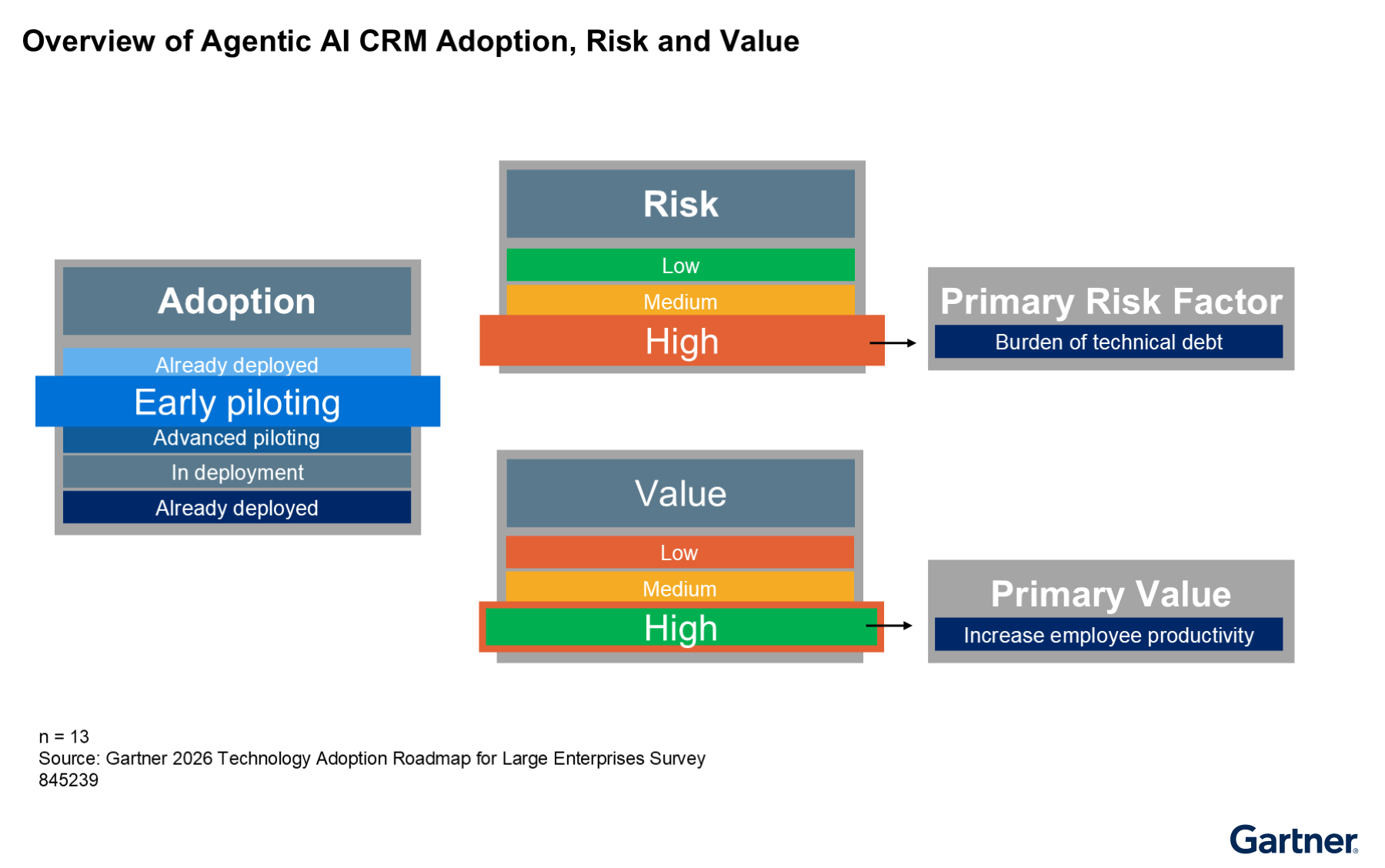
That risk profile makes sense for enterprises trying to retrofit agentic AI onto legacy CRM infrastructure built over decades. The technical debt is real. The integration complexity is real. The governance challenges are real.
But for a system built natively agentic, where the AI isn't bolted on but is the foundation, that risk profile looks different. There's no legacy system to integrate. There's no technical debt from a pre-AI architecture. The governance challenge of traceability and auditability is addressed structurally by SQL, rather than requiring an additional compliance layer on top.
And running on Claude means the model choice problem is also structurally solved. As better models arrive, the intelligence improves. No re-architecture required.
The simple version
Here's what all of this distills to.
The CRM market is reorganizing around AI that acts, not AI that responds. Gartner has mapped it, the big vendors are racing toward it, and the window for point solutions is closing.
The products that will define this next era share a few traits. They understand your organization's data specifically, not generically. They surface insights that are traceable and auditable. They work within open model architectures that improve as AI improves. And they make the human more effective, not more dependent on the machine.
The conference badge is just where we meet you. What you actually get is Alani Insights: AI-native databases you build and curate yourself, ready for agents to orchestrate, that know your data, speak your schema, and think in your context from day one. ConferenceCRM is one. Yours is next.
Gartner called the category. We've been building it, and now you can build on it too.
Want to build an AI-native database your agents can actually use? Start free on Alani Insights with $20 in credits on us, no credit card required.
Prefer to see it in action first? ConferenceCRM is the conference version, free to try at conferencecrm.com.
Source: Gartner, Innovation Insight: Agentic AI in CRM, February 2026. Gartner does not endorse any vendor, product, or service depicted in its research publications. The opinions in this article are bundleIQ's own.

Ready to put your information to work?
Pick a product. Start free or talk to our team.