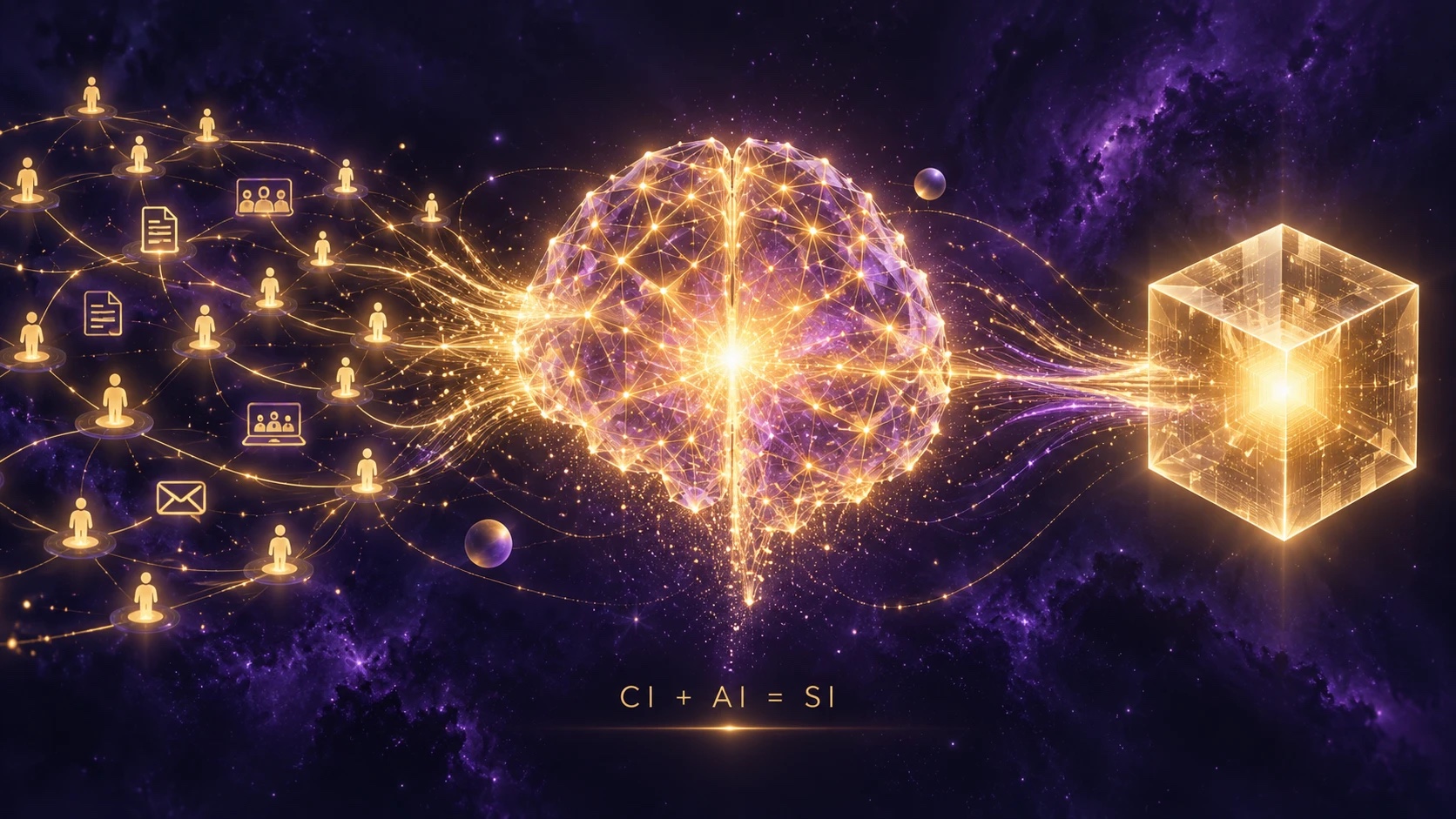
The President renamed artificial intelligence "superintelligence" at the United Nations this week. The reaction was immediate: the word already has a technical meaning. But the equation he put on the table is the one bundleIQ was built on. It is just missing half.
This week the President of the United States stood at the United Nations and renamed an entire industry. "Welcome to the new world of superintelligence," he told the General Assembly, after two rounds of Truth Social polls that narrowed the choice to "Super Intelligence" versus "Superior Intelligence" (Trump, 2026a, 2026b). From this point forward, he said, "all of the United States documents and hopefully the world's will be changed to use the much more accurate term super as opposed to artificial" (DiMella & Lachter, 2026; Revell, 2026).
The objection came fast: superintelligence already has an established meaning. Nick Bostrom defined it in a 1997 paper as "an intellect that is much smarter than the best human brains in practically every field, including scientific creativity, general wisdom and social skills" (Bostrom, 1998). And Bostrom was not selling a vibe. He was warning about a machine that could outthink us all.
But here is what almost nobody said: there is a second, older tradition of thinking about intelligence that operates above the individual brain, and it points to a different equation. It is the one we built bundleIQ on.
The half everyone forgets
In 2018, Thomas Malone, founding director of the MIT Center for Collective Intelligence, published a book called Superminds (Malone, 2018a). The thesis was simple and, at the time, unfashionable. Intelligence is not a property of individual brains. It is a property of groups. Malone defines a supermind as "a group of individuals acting together in ways that seem intelligent," and argues that superminds like hierarchies, markets, democracies, and communities have been responsible for almost all human achievements (Malone, 2018b). Markets, democracies, companies, scientific communities, the internet itself. These are superminds, and they have been outperforming any single human for centuries.
Malone's prediction was that the next leap would not come from machines replacing human minds. It would come from machines joining the group. In his words, "we should move away from thinking about putting humans in the loop to putting computers in the group," and doing so will "create superminds that are smarter than any groups or individuals our planet has ever known" (Malone, 2018b). Collective intelligence plus artificial intelligence. Humans and computers thinking together in ways neither could alone.
Bostrom would not call that superintelligence. His paper is explicit that companies and scientific communities do not qualify, because they are not single intellects (Bostrom, 1998). Malone's superminds explicitly include them. So the equation below is our synthesis, not Bostrom's definition, and we think it is the more useful one. Superintelligence is not a god in a server rack. It is a better supermind.
CI + AI = SI.
Why "artificial" was always the wrong word
Trump's instinct was that "artificial" undersells the thing. His first poll called the phrase "inaccurate, and very ineloquent" (Trump, 2026a). Fair enough. But "super" as he means it, a machine that wins a race against China, still gets the physics wrong.
The intelligence in your company does not live in a model. It lives in your people, your customers, your meetings, your emails, your decisions, your mistakes. That is collective intelligence, and it has been accumulating since the day you opened the doors. Most of it is invisible, locked in inboxes and documents and the heads of people who might leave next quarter.
AI without CI is a brilliant intern with amnesia. It knows everything about the world and nothing about you.
CI without AI is a library with no librarian. The knowledge is there. Nobody can find it fast enough to matter.
Put them together and something changes in kind, not degree. The organization starts to think. That is the "super" part. Not superior to humans. Super because it includes them.
What we built
We started bundleIQ on this premise before large language models made it fashionable. Our first chat-with-data deployment ran at the World Bank before ChatGPT existed, on models most people have never heard of. The bet was never that AI would replace the knowledge worker. The bet was that AI would finally make collective knowledge usable.
Alani, our AI, is built as a context layer. It sits on top of the collective intelligence your organization already has, whether that is a founder's ten years of notes, a publisher's community of readers, or an enterprise's CRM and meeting history. The AI is the part that reasons. The CI is the part that makes the reasoning worth anything.
The race Trump is describing is real. The finish line isn't.
Trump framed it as a contest. "Whoever wins superintelligence, wins. That's the group that wins," he told the General Assembly. "We're leading now over China by a lot and everyone else" (CNBC, 2026; Revell, 2026; Trump, 2026c). He is right that it is a contest. The question is what you win it with.
The country, company, or community that wins SI will not be the one with the biggest model. Model access is commoditizing fast. Every serious competitor can rent frontier capability through the same handful of APIs. What no one can rent is your collective intelligence. Your relationships, your history, your judgment, your data, the thousand small decisions that only your organization made.
That is the moat. AI is the multiplier. SI is what happens when you connect them.
So yes, welcome to the new world of superintelligence. It was always going to be called that. It just was never going to be artificial.
CI + AI = SI. Let's build superminds.
References
Bostrom, N. (1998). How long before superintelligence? International Journal of Futures Studies, 2. https://nickbostrom.com/superintelligence
CNBC. (2026, September 22). Trump: We're going to encourage 'super intelligence,' not rein it in [Video]. https://www.cnbc.com/video/2026/09/22/trump-were-going-to-encourage-super-intelligence-not-rein-it-in.html
DiMella, A. J., & Lachter, E. (2026, September 22). Trump flexes American power at UN with warnings to rivals around the globe. Fox News. https://www.foxnews.com/politics/trump-flexes-american-power-un-warnings-rivals-around-globe
Malone, T. W. (2018a). Superminds: The surprising power of people and computers thinking together. Little, Brown Spark.
Malone, T. W. (2018b). How human-computer "superminds" are redefining the future of work. MIT Sloan Management Review, 59(4), 34–41. https://sloanreview.mit.edu/article/how-human-computer-superminds-are-redefining-the-future-of-work/
Revell, E. (2026, September 22). Trump vows to reject 'globalist scheme' to rein in AI, superintelligence. Fox Business. https://www.foxbusiness.com/politics/trump-rebrands-ai-rejects-globalist-scheme-control-tech
Trump, D. J. [@realDonaldTrump]. (2026a, September 19). Many people think that the words "Artificial Intelligence" are inaccurate, and very ineloquent, relative to AI, or Artificial Intelligence [Post]. Truth Social. https://truthsocial.com/@realDonaldTrump/117298413844042212
Trump, D. J. [@realDonaldTrump]. (2026b, September 21). Which name do we like for the new phenomena — SUPER INTELLIGENCE VS. SUPERIOR INTELLIGENCE? [Post]. Truth Social. https://truthsocial.com/@realDonaldTrump/117309799376551907
Trump, D. J. [@realDonaldTrump]. (2026c, September 21). The same people that said, "We'll all be dead in twelve years because of Global Warming" ... Whoever wins AI, WINS! [Post]. Truth Social. https://truthsocial.com/@realDonaldTrump/117309814170246776


Ready to put your information to work?
Pick a product. Start free or talk to our team.