The Business That Builds Itself
For decades, businesses have adapted to software. Artificial intelligence is beginning to reverse that relationship.
The argument in 30 seconds
- 1For decades, businesses shaped their work around applications. AI agents can now do much of that work without anyone opening the application.
- 2As models and interfaces become interchangeable, a business's own structured records become the most stable thing it owns.
- 3The cost of creating and adapting business software is falling. When the work doesn't fit an existing application, an agent can help shape a system around it, a person approves it, and the organization keeps the record.
The next generation of business software won't begin with an application. It will begin with a problem, an agent, and a system of record.
Every business has a collection of systems it has learned to live with.
A CRM for customers. A project management tool for work. A spreadsheet for the things that don't quite fit anywhere else. A shared drive full of documents. An accounting platform. A few applications that someone introduced years ago, which nobody quite remembers how to replace.
Each system solved a problem. Together, they created another: information scattered across applications, and people responsible for keeping it all connected.
Now an AI agent can do much of the work that once meant navigating several of those applications. That creates a problem that isn't immediately obvious. An agent can analyze hundreds of companies in a single conversation, and when the conversation ends, the results sit in a transcript or a spreadsheet that nobody will maintain.
The intelligence completed the task. The business didn't gain a system it could keep operating.
An answer is not a record. A conversation is not a system of record. And an agent completing a task is not the same as a business becoming more capable.
The next chapter of AI depends on closing that gap: giving an agent's work a reliable foundation to accumulate on. And that raises a more interesting possibility. What if a business no longer had to begin by choosing the software that defines how it operates, and could begin by describing the work instead?
That is the argument of this essay. The business should define the work. The agents should help shape the software. The organization should retain the record.
01 / 07
We built businesses around software
The history of business software is a history of specialization. Customers, projects, events, hiring, support: each kind of work gained its own category of application and its own vendors.
Every one of those applications arrived with a point of view: its own interface, its own data model, its own idea of what a customer or a candidate is. Adopting one meant adopting that point of view. Teams renamed their stages to match the dropdown. They tracked the fields the form provided and quietly dropped the ones it didn't. When the work did not fit, the work changed.
This was a reasonable trade. Custom software was expensive, slow, and risky, and a packaged application encoded years of other people's experience. But the cost compounded quietly. Each application was another place where records lived, another export, another integration to maintain. A large share of modern office work is not the work itself. It is keeping the systems that describe the work in agreement with each other.
None of this means software as a service has failed. Applications are not disappearing. What is changing is their relationship with the people who use them, the agents that increasingly act for those people, and the data underneath.
Next · 02If businesses bent to their software for decades, what changed? The intelligence moved.02 / 07
Intelligence has separated from the application
Until recently, the intelligence in business software lived inside its interface. To get value, a person went to the application, learned its screens, and worked inside them.
General-purpose AI assistants have broken that coupling. A person can now ask an assistant to research a list of prospects, draft a proposal, compare contract terms, or plan a launch, and the assistant does the reasoning without anyone opening the application that will eventually hold the result. Open standards such as the Model Context Protocol let the same assistant reach many systems through one consistent kind of connection.
Two consequences follow. For a growing share of tasks, the conversation is the interface. And the intelligence itself is becoming interchangeable: a team might use one model this quarter and another next quarter, or several at once.
When the interface and the intelligence can both change, the question becomes: what doesn't?
Next · 03When the conversation becomes the interface, where does the finished work go?03 / 07
The work has nowhere reliable to go
Consider a simple, common task. An agent is asked to research 500 companies that might buy a new service: who they are, what they do, who leads the relevant function, and how well each fits. It does the work well. The output is a long, thoughtful answer, perhaps with a table, perhaps exported to a spreadsheet.
A week later, a colleague asks a different agent to plan outreach to the best fifty. That agent has none of the first one's work. It can be handed the spreadsheet, if someone remembers where it is and trusts that it is current. It cannot know which companies were already contacted, which contacts bounced, or which fit scores a person corrected by hand. So it starts over, or it reconstructs the context imperfectly, or it asks a person to do the reconciling.
An answer
Northwind Logistics looks like a strong fit. Their VP of Operations, Dana Ruiz, joined in March, and they are expanding into two new regions. I'd prioritize them this quarter.
Shaped for a reader, at one moment. Gone when the conversation ends.
A record
- company
- Northwind Logistics
- contact
- Dana Ruiz → People
- fit_score
- 8 corrected by a person
- stage
- qualified
- next_step
- Intro call · due Dec 4
Shaped for use over time. The next agent, and the next person, picks it up.
This is the gap between producing an answer and building a durable operational asset. An answer is shaped for a reader at one moment. An asset is shaped for use over time: records with stable identities, fields that mean the same thing every time, links between a person, their company, and the deal they are part of, and definitions that say what each value means.
Most agent work today ends as answers. That is fine for questions. It is a poor fit for operations, where the value is in what accumulates: the customer list that gets better each week, the hiring pipeline that remembers every candidate, the event calendar that many people contribute to and many more rely on.
Next · 04If the work has nowhere to go, what should hold it?04 / 07
The system of record becomes more valuable
Here is the center of the argument. As interfaces become conversational and intelligence becomes interchangeable, the durable, structured record of a business becomes the most stable thing it owns.
Models will be replaced. Assistants will come and go. Applications will be redesigned, adopted, and retired. But an organization will still need to know who its customers are, what it has promised them, what it has been paid, which decisions were made, and by whom. Those facts outlive every tool used to collect them.
A system of record in this sense is not a file or a transcript. It has properties that conversations do not:
- Structure. Records have defined fields and types, so a date is a date and a stage is one of a known set.
- Identity. Each record can be found again and updated, rather than restated.
- Relationships. A person points to a company, a deal points to both, and the links hold.
- Meaning that travels. Field definitions explain what a value means and who may change it, so a new agent, or a new employee, reads the same rules as the last one.
- Access. Who and what can read, create, update, or delete is decided per table and per action.
- People in the loop. Humans can open the same records, see what an agent wrote, and correct it.
Agents make the case for these properties stronger, not weaker. A person working in a messy spreadsheet carries the missing context in their head. An agent does not. It needs the context written down, in the data, every time.
The interface can be anything. The intelligence can be anyone's. The record has to be the business's own.
05 / 07
Software begins to form around the work
Once the record is stable, the software around it no longer has to be. That loosens an assumption so old it rarely gets stated: that building a system for a piece of work is expensive, so a business should buy one and adapt to it.
For decades, a business that needed a system had two choices. It could adapt its process to an existing application, which was affordable and rigid. Or it could pay developers to build something custom, which fit, but cost months and a budget most small organizations never had. So most work that didn't fit a product ended up in spreadsheets, inboxes, and people's heads.
AI agents introduce a third possibility. Describe the work, have an agent help design the operational system, approve it, and adapt it as the business evolves.
Imagine the order reversed. A small team describes what it actually needs: we track the companies we sell to, the people we talk to there, the deals in progress, and what we promised to follow up on. An agent proposes tables and fields to hold that, with a written description of what each field means. A person reviews the proposal, changes what doesn't fit, and approves it. The agent creates the structure, brings in existing records, and begins doing the work. When the business changes, the structure changes with it, through the same conversation.
- Person Describe the work, in plain language
- Agent Propose tables, fields, definitions
- Person Approve change what doesn't fit
- Agent Create structure and clean imports
- Both Operate and reshape as the work changes
The economics are the real shift. The cost of a first version of an operational system, and of its tenth revision, is falling far enough to change who gets to have one. A five-person firm, a volunteer committee, a nonprofit program team: organizations that could never justify commissioning software can now shape a system around how they actually work. And when something gets cheap enough to change, a business stops having to commit to it in advance.
None of this makes software development, maintenance, or governance disappear. Someone still has to understand the business, decide what the system should hold, and take responsibility for it. Agents propose structures that are wrong, and they need a person who knows the work to say yes. What changes is the cost of trying, and of correcting course.
Nor is this an argument that today's applications are going away. Established CRMs, project tools, and flexible workspaces will stay valuable, and agents will increasingly work inside them. The opportunity here is different: when the work doesn't fit an existing application, a business should be able to create an operational system around its needs without commissioning custom software.
The business should define the work. The agents should help shape the software. The organization should retain the record.
06 / 07
The business needs a foundation of its own
If records are the stable center, then where they live and how they are governed matters more than it used to. Four properties stand out.
An organization's records should be its own, separate from other organizations' records, and structured around its work rather than around a vendor's feature set.
When several agents and several people work on the same records, the definitions have to live with the data. A field called status is useless to a new agent unless the data itself says what each status means and who sets it.
An agent that researches prospects might create and update records in one table and only read another. That boundary should be set by a person and enforced by the system, not left to the agent's judgment.
The people responsible for the business must be able to open the records, check them, and fix them, without building an admin tool to do so.
The first property changes the most. For most of the history of business software, the application has been the organizing principle for operational data. The CRM holds the customers, the project tool holds the tasks, the event platform holds the attendees, each shaped by its vendor. A business's picture of itself is spread across whichever products it happened to buy.
A dedicated foundation makes a different arrangement possible: the business becomes the organizing principle. The organization keeps a durable operational foundation, and authorized agents and applications work with it. That matters in three ways.
- Continuity. When a team changes models, assistants, or applications, its records, their definitions, and the links between them stay where they were. The next tool starts from what the business already knows.
- Adaptability. When the business changes, it changes its own structure, rather than waiting on a vendor's roadmap or migrating to a new product.
- The relationship. Software becomes something that works with the business's records, rather than a container the business has to fit into.
This is why every Alani Insights organization receives its own separately provisioned database, rather than sharing one with every other customer. A dedicated database is not the same as unrestricted ownership, guaranteed portability, or guaranteed security; those depend on access controls, export options, and the people who manage them. It also does not mean consolidating everything. Financial systems, regulated data, and specialized applications often belong where they are. The claim is narrower: new work, and the work that falls between a business's systems, can accumulate somewhere that belongs to the business rather than to the tool of the moment.
None of this means every organization should run its own database servers. Most should not. The point is about ownership and shape, not about who patches the machines. A business can have a foundation of its own that someone else hosts, in the same way it has a bank account at someone else's bank.
07 / 07
What becomes possible
Picture a small organization a few years from now. It does not have a separate application for every function. It has a set of records that belong to it: customers, partners, projects, candidates, events, commitments. Several agents work on those records, each with access to the tables its job requires. People open the same records in a plain interface to review, correct, and decide. When the organization takes on something new, a program, a hiring push, a partnership, it describes the work, approves a structure, and starts. When the work ends, the records remain.
That organization still buys software. It still uses specialized applications where they are clearly better. What it no longer does is wait for the right product to exist before it can organize a new piece of work, or rebuild its process each time it changes tools.
This is the direction we are building toward at bundleIQ with Alani Insights. It is worth being precise about what exists today and what is still ahead.
What exists today
Alani Insights is where we are building it. Today it gives each organization its own database, tables whose fields describe themselves, agent access through MCP or an API that can be limited table by table, and an app where people see and correct the same records. Two examples show the two halves of the argument.
Evidence one · A real application on a system of record
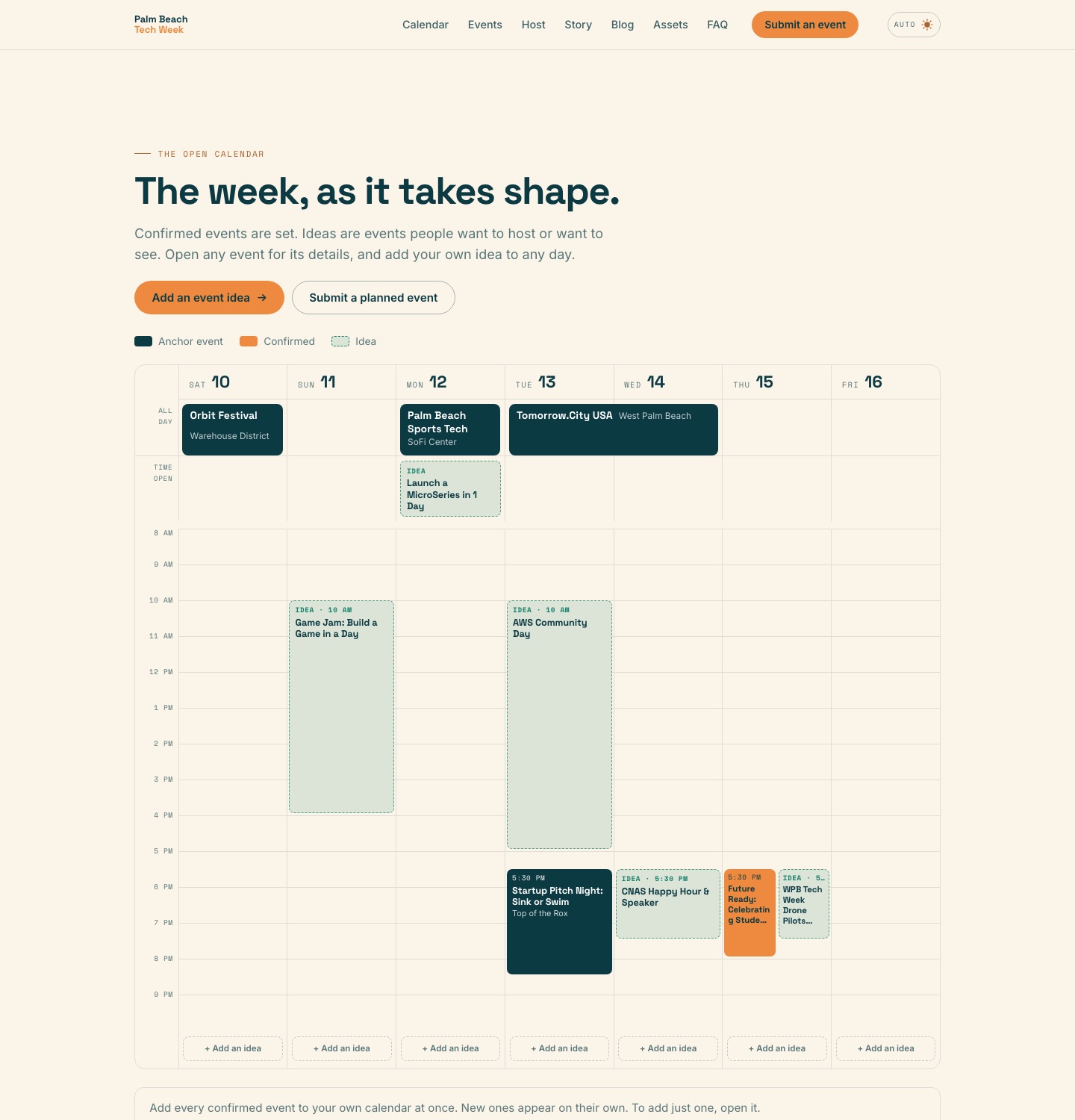
Palm Beach Tech Week
A community-led week of events in West Palm Beach. Its site takes event submissions from many independent organizers, lets a few volunteers approve them, and publishes an open calendar, with no database server and no records management tool built for it.
- 3tables: Events, People, Companies
- 1admin page built: a small review queue
- 0database servers to run
The site itself is a conventional application that reads and writes its records over an API. No autonomous agent runs it, and it is early. What it shows is the first half of the thesis: a dedicated, self-describing set of records can sit underneath an application people rely on, with the people running it reviewing the same records directly.
Evidence two · An agent establishing a new system
An agent-run CRM
Our worked example takes an agent from an empty workspace to a working CRM: companies, people, opportunities, and activities. The agent and its human agree the design first. The agent creates the tables, brings in existing contacts, logs an interaction, and lists the follow-ups that are due.
- 4linked tables
- 27described fields
- <1 minto create, in our testing
What is still ahead
The pieces work today, in tested examples with a person approving each design. What we are building toward is the whole sequence as an everyday experience: someone describes a new piece of work in conversation, an agent proposes the system, a person approves it, and the business is running on it that afternoon, adapting it as it learns. Teams most often start with a client pipeline, a research list, recruiting, event and sponsor operations, or vendor tracking.
NextNow the strongest arguments against all of this.Fair objections
An argument this broad deserves pushback. These are the objections we take most seriously.
Not every business needs a new database.
True. Many teams are well served by the applications they have, and the right move for them is to connect agents to those systems. The argument here is about new work and work that has never fit a product, not about replacing what already works.
Existing applications are gaining agent capabilities.
They are, and that is good for their users. An agent inside one application is still bounded by that application's data model. The question we are raising is where records live when the work spans several tools, or when no tool fits.
Notion, Airtable, and established databases already solve much of this.
Substantial parts of it, yes. Flexible workspaces and databases have offered user-defined structure for years. What changes is who defines and operates that structure. When agents do most of the reading and writing, self-describing schemas, per-table access, and an organization-level boundary around the data matter more than a flexible page.
Agents make mistakes: wrong records, duplicates, unsafe changes.
They do. That is the strongest reason to give them a system of record rather than a pile of files. Required fields and fixed choices reject bad values, scoped keys limit what an agent can touch, and people can see and correct every record. The design assumes errors and makes them visible and reversible by a person.
Why trust an agent to design a business's systems at all?
Writing a wrong record is one kind of mistake. Designing a poor structure is a larger one: the wrong relationships, fields that are too rigid, or information the business will need later left out. That is why, in this model, agents propose and people approve, and why the structure has to stay easy to revise. The most valuable thing AI may do here is lower the cost of designing and revising operational systems, not replace the judgment of the people who know the business.
A dedicated database does not automatically provide portability, governance, or trust.
Correct. Separation is a foundation, not a guarantee. Governance comes from access controls, clear definitions, and people who use them. Portability comes from standard interfaces and the ability to take your records with you. Those still have to be earned.
Most businesses would rather extend existing software than replace it.
Most should. The model above does not ask anyone to rip out a CRM or an accounting system. It adds a place for the work that falls between systems, and for the new systems a business would otherwise build in spreadsheets.
Where this leads
For decades, the first step in organizing a piece of work was choosing an application. That step is becoming optional. A business can start with the problem, ask an agent to propose a structure, approve it, and begin, with the records kept somewhere that belongs to the business and outlasts every model and interface it uses along the way.
The consequence is larger than data architecture. A small business could establish systems it could never have afforded to commission. A growing organization could adapt its operations without replacing its applications every few years. And the people doing the work could spend less time maintaining software, and more time exercising judgment, building relationships, and solving the problems they were hired to solve.
For a long time, the question was which software a business should buy. The more interesting question now is what a business could build if its software no longer determined the shape of its work.
The next generation of business software won't begin with an application. It will begin with a problem, an agent, and a system of record.